Those with heart disease, hypertension and other blood pressure issues should be watching their salt intake. That’s because salt can drive up blood pressure and cause heart attacks and other problems, especially over a lifetime of excess salt consumption. It’s all due to an imbalance of sodium and potassium. The requirement for potassium is far greater than sodium, and most never get enough potassium. When was the last time you consumed the recommended dietary allowance for potassium … 4700mg? It’s a very high target to reach, few do. When you do, you do not have to worry about your sodium.
It may surprise you, but there are many types of salt out there, ranging from simple table salt to specialized salts that can be nutritional in their own right. But at the center of all salts is the sodium content. Most salts have between a 40 and 60 percent concentration of sodium, and a teaspoon of table salt contains about 2,300 mg of sodium — the max suggested daily intake of salt for the average person.
But if you’ll notice, that small teaspoon isn’t that much salt, and many foods are loaded with salt to keep them fresh and tasty, making it far too easy to have too much salt in a given day. Day after day and week after week, that salt surplus can start affecting your health in very serious ways.
That said, most table salt is fortified with iodine, and other salts, such as sea salt, may include other minerals such as calcium, magnesium and potassium, all of which can slightly affect taste. On the other hand, kosher salt is iodine free and contains no additives.
How Much Sodium per Day With High Blood Pressure?
While everyone needs salt each day to exist and to optimize the body’s function, those with high blood pressure will need to watch their salt intake. Most adults need about 1,500 mg of sodium each day until about the age of 50, after which the daily requirement drops to 1,300 mg, with another drop to 1,200 after 70.
Generally, the sodium limit is 2,300 mg a day, though many people actually get closer to 3,000 mg a day due to poor diets and food choices. Those with high blood pressure need even less, and many experts recommend no more than 2,000 mg a day.
Reducing Your Sodium Intake
One of the best ways to positively affect your blood pressure is to reduce your sodium and increase your potassium…eat 5-7 servings of fruits and vegetables a day. Fruits and veggies are low sodium and high in potassium.
Others may turn to salt substitutes such as potassium chloride and potassium iodide, which are sodium free. Other salts known as half-salts or lite salts have roughly 50 percent less sodium, and they can be good options for those that are watching their salt intake. Some salts may simply be a blend of spices and herbs and contain no salt at all, and some people may prefer to flavor their foods with fresh herbs, lime or lemon juice, as well as garlic or ginger.
But while adding less salt to your meals can help you reduce your salt intake, more than three-quarters of all the salt we consume isn’t from the salt shaker, it’s from packaged foods and snacks like chips, fries and baked goods, not that main entree.
Instead of packaged foods and other goods that are laden with salt, those with high blood pressure need a salt alternative that won’t spike the sodium levels in the body. In fact, traditional table salt or sea salt has way too much salt (sodium) in it by volume to be very useful as a food additive, and it only takes a small amount to exceed the desired levels of sodium in the body. Making matters even worse, as sodium levels rise in the body, it can throw your other important electrolytes out of whack, reducing your performance and leading to other problems.
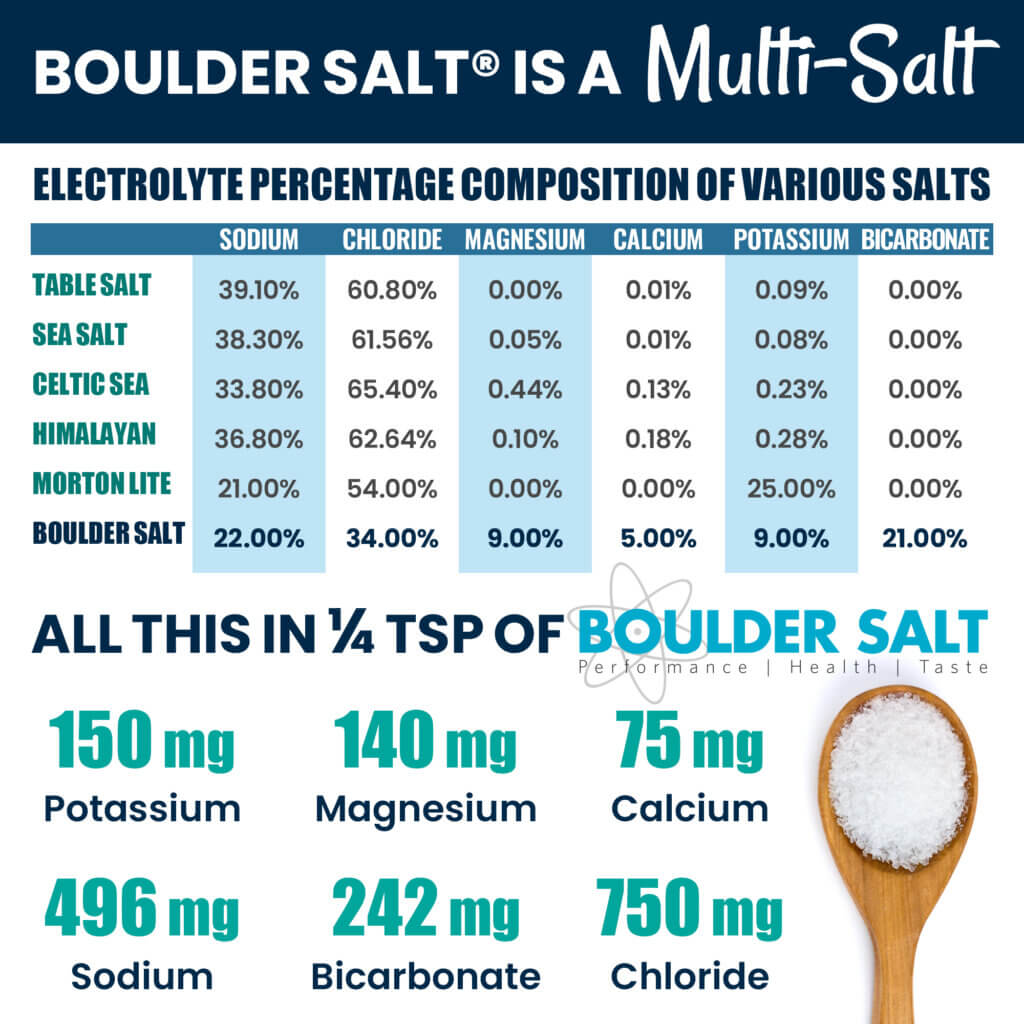
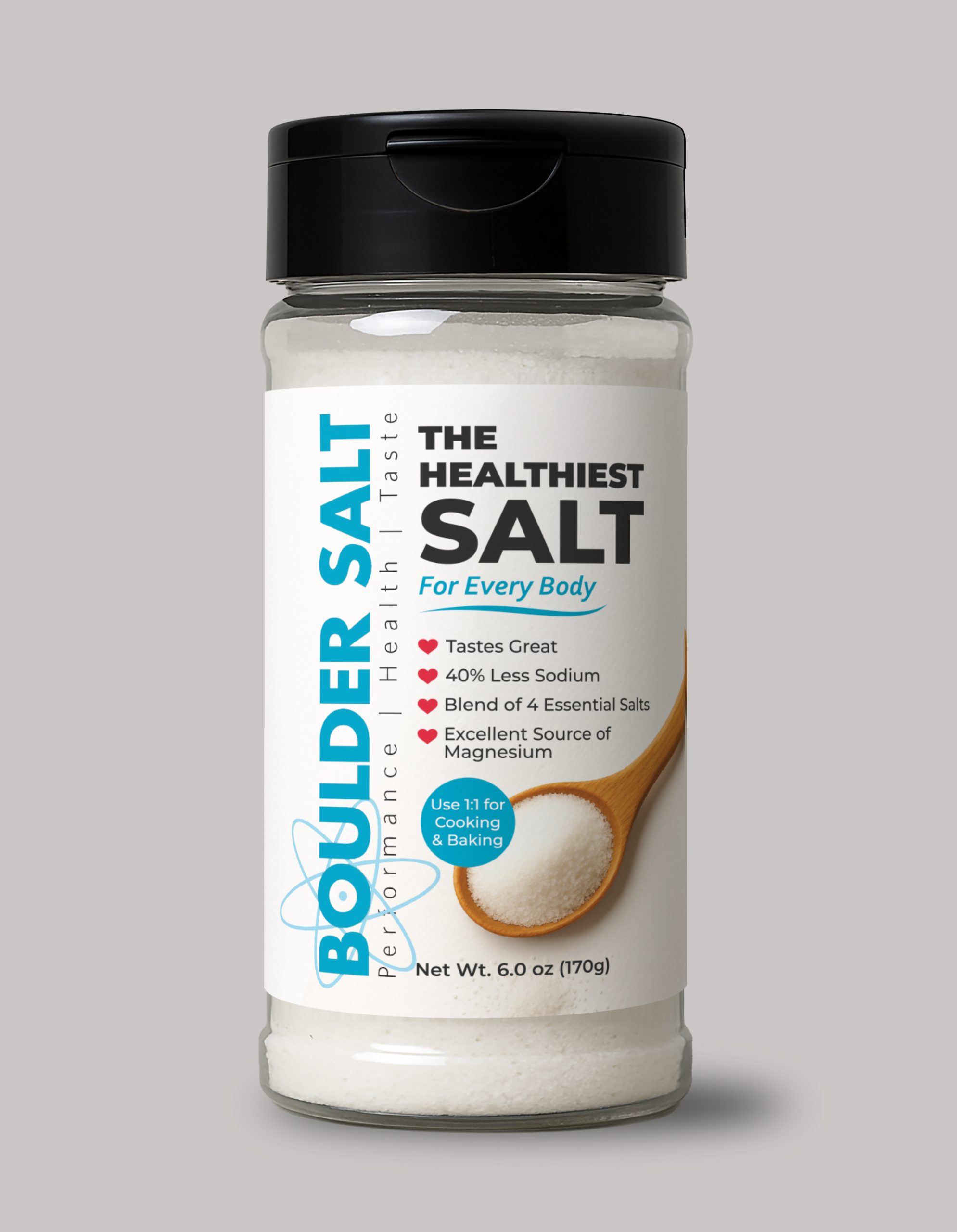
To remedy this, you need the best salt for high blood pressure: Boulder Salt. Table salt and sea salt are almost entirely made of sodium chloride while Boulder Salt contains 40% less sodium than that. The “Boulder Salt difference,” however, is not “less sodium.” Rather it is the inclusion of the ideal amounts of potassium, magnesium, and calcium that make Boulder Salt the potent nutritional asset that puts it in a category by itself compared to all other salts. Additionally, it also contains other useful electrolytes, just like your favorite nourishing beverages, and everything’s been optimized for athletic function and performance.
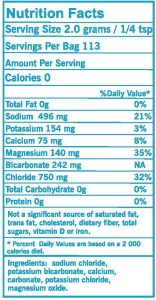
In addition to 496 mg of sodium, Boulder Salt contains 150 mg of potassium, 140 mg of magnesium, 75 mg of calcium, 242 mg of bicarbonate and 750 mg of chloride. With all the salts that the body needs, Boulder Salt is simply the best salt for high blood pressure and those that want to optimize their salt intake. Some people call it a special salt for high blood pressure — we just know that it helps get that optimum level of sodium for your needs.
Check out our online store here to buy your first bag today!
How is Boulder Salt different from other salt products meant for athletes?
Most performance related salt products on the market are close to 100% sodium. Our bodies need a variety of electrolytes to perform at optimal levels – not just sodium. Boulder Salt provides a robust, alkaline blend of electrolytes, including sodium, potassium, magnesium and calcium. And in a combination that approximates what should naturally exist in the body. This ratio can help athletes optimize their performance.
How much Boulder Salt can or should I use in a day?
It varies depending on your activity level and sweat rate. In general 4 servings is common for everyday use, up to 6 servings for endurance athletes.
If you are under the care of a physician for a medical condition, consult your doctor first.
Why doesn't Boulder Salt have flavorings?
Boulder Salt is unique in that it can be taken alone, added to water, or mixed with other beverages to up their electrolyte value. It also gives you the option to make your own sports drink – adding flavors and/or sweeteners that work for you.
Can I mix Boulder Salt with my sports drink? Or add it to just plain water?
Yes. If you’re looking to enhance your electrolyte levels, Boulder Salt® is an ideal way to do so! It can be added to both water and sports drinks. You will likely be surprised at how mellow it tastes in water alone. And it will not significantly alter the taste of most beverages. However, Boulder Salt is alkaline, so if you add it to an acidic sports drink (which many are), you can expect to see the drink temporarily “bubble” or foam-up.
Should I drink it before, during or after training or competition?
Athletes have used Boulder Salt® during all phases of a competitive event – whenever they are accustomed to drinking water or another sports drink. It’s balanced level of electrolytes make it an ideal addition to your electrolyte replacement regime. It can help you shore up electrolytes, hydrate quickly and help prevent or eliminate cramping.
If you are undergoing treatment for a medical condition, consult your physician.
What does Boulder Salt® taste like?
Boulder Salt® is a soft, mellow-tasting salt. The varying size and shapes of different salts provide a unique taste experience. The tiny calcium and magnesium salts, which are very mild tasting, cover the surface of the sodium and potassium crystals and provide for a mellowing of the familiar “bite” of those salts.
Health Related Questions
Is Boulder Salt a good way to reduce sodium in my diet?
Yes. Boulder Salt® has nearly ½ the sodium per serving than traditional table salt. And it has a ratio of potassium to sodium, that helps the body maintain a healthy blood pressure.
I have high blood pressure and my doctor said I need to cut back on sodium. Is Boulder Salt a good alternative to Morton's or sea salt?
YES! Boulder Salt® is much lower in sodium chloride than traditional table salt , sea salt, and Himalayan pink salt – which are all over 95% sodium, making Boulder Salt a much healthier alternative!
What does it mean to akalanize the body, and what role does Boulder Salt serve?
Alkalinizing the body means means shifting your body from an acidic state to a more neutral or alkaline state. Our normal state of being should ideally be slightly alkaline. However, environmental factors, stress, a diet low in fruits and vegetables or high in meats and other processed foods, and especially carbonated drinks, can all push our systems into an acidic state. When your body is closer to an alkaline state, you’ll experience fewer illnesses, be better prepared to fight off disease, and simply feel better. Unlike traditional table sale and sea salt, Boulder Salt® is alkaline.
General Questions
Can Boulder Salt be used in place of other salts in cooking and baking?
Absolutely! Boulder Salt® can be used as a 1:1 replacement for any other salt in food preparation, baking and cooking.
What are the nutrition facts for Boulder Salt®?
Why does Boulder Salt look different from other salts on the market?
Boulder Salt® looks different from other salts due to the fact that it is made up of a variety of salts, rather than just one type. Both the chemical composition as well as the particle sizes of the various salts used in Boulder Salt® are different. If you looked under a microscope, you’d see that some of the salts look like “boulders”, while others are much smaller.
What is in Boulder Salt?
Boulder Salt® is a blend of naturally occurring salts including sodium, potassium, magnesium, and calcium , which are all critical on a biological level.
Where does Boulder Salt come from?
The ingredients in Boulder Salt are chosen based on purity, not location. We take 4 different salts and blend them together in a particular ratio to make Boulder Salt. We only use pharmaceutical grade or USP grade salts.
How do you calculate that Boulder Salt has 40% less sodium than other salts?
1/4 Teaspoon of “regular salt” weighs 1.5g while 1/4 Teaspoon of Boulder Salt weights 2.0g (more dense). Once this difference in density is taken into account, the 40% difference can be shown. For example: A typical brand of salt shows 585 mg. of sodium in 1/4 tsp. (1.5g).
The sodium in 2.0g is given by 585 x 4/3 = 780mg How much less sodium is in Boulder Salt is given by: 780-480=300 300/780 = .385 or 38.5% less (rounds to 40%)
How is Boulder Salt different from traditional table salt and sea salt?
Boulder Salt has nearly half the sodium of traditional table salt and sea salt. It also has potassium, magnesium and calcium – salts that are all critical on a biological level. (Traditional table salt is 99% sodium). Boulder Salt looks a bit different too, It has a finer texture than most other salts on the market and a more mellow taste.
How much Boulder Salt should I put in my water, or other beverage of choice?
The precise amount of Boulder Salt® to add to your drink depends on your sweat rate. One quarter teaspoon in a 17-20 oz drink is the recommended starting point.
Boulder Salt doesn't seem to dissolve completely, when added to water. What is that?
The material you see that doesn’t dissolve is related the larger particle size of magnesium and calcium. It’s around 4% of the total. These particles do readily dissolve when they are exposed to an acidic environment such as in the stomach. They will dissolve right away if you keep them agitated/stirred up and drink the water with them suspended in it.
Why does Boulder Salt look different from other salts on the market?
Boulder Salt® looks different from other salts due to the fact that it is made up of a variety of salts, rather than just one type. Both the chemical composition as well as the particle size of the various salts used in Boulder Salt® are different. If you looked under a microscope, you’d see that some of the salts look like “boulders”, while others are much smaller.
Why doesn't Boulder Salt have iodine?
We do plan to offer our product in the future, with iodine. Our current formulation does not have iodine because it tends to have a metallic taste when added to water. If used simply on foods, it does not have that strong of an aftertaste. The current formula of Boulder Salt® is intended to be used in both water and on food.
What role can Boulder Salt play in EMS protocols (specifically at endurance related events)?
In this video Dr. Ahmed Stowers explains the role that Boulder Salt® plays in his treatment of dehydrated patients.
Where can I buy Boulder Salt?
Boulder Salt® is available here on our website, on Amazon, and in several states including California, Colorado, Hawaii – Kona, Massachusetts.
Do you offer bulk discounts?
Yes, we are happy to offer discounted pricing on bulk orders. Just contact us or send us an email with your requirements and we’ll give you a call by the next business day!