
Salt tends to get a pretty bad rap in the media and it is often deserved!
Of course, when it comes to our diets, salt isn’t intrinsically good or bad. Using the right salt, however, can do our bodies a world of good, while the wrong one can be problematic at best. While almost every salt provides the sodium we must have, the imbalance arising from their lack of other essential elements often leads to harmful side-effects. These unintended consequences are mentioned often in literature and in person by nutritionists and sometimes doctors. The one balanced salt, our very own Boulder Salt, offers key health benefits with none of the harm. All other salts have various drawbacks that warrant caution and should be understood before using them.
With this in mind, let’s take a look at the top five salt health benefits.
Salt is largely made up of two minerals: sodium, and chloride. These minerals also function as electrolytes which help your body to carry out many of its functions.
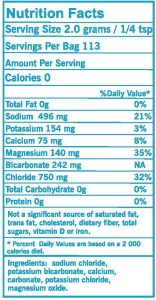
Sodium and chloride aren’t the only minerals in the highest quality salt though. In Boulder Salt you also get magnesium, calcium, potassium, and bicarbonate. Not all salts are created equal though, so it can be handy to see what electrolytes you’re getting.
In the right ratio these electrolytes provide numerous key salt health benefits. In several ways they help our bodies to function, and for athletes, they can even prevent muscle cramping during intense exercise.
We tend not to hear much about the positive correlations between salt and health, but it plays a key role in keeping our bodies hydrated.
Along with potassium and chloride, sodium helps deliver water to the cells.
We’re all aware of the dangers of too much sodium in processed diet, but it does have its benefits. Sodium is an important part of a balanced diet, so rather than avoiding it altogether, it’s best to follow Centers for Disease Control (CDC) Guidelines
For athletes, this health aspect is particularly important. Your body needs to stay hydrated to maintain peak performance, but as you exercise you sweat, which releases both water and salt from the body. To maximize recovery, you need to replace lost sodium, along with other electrolytes.
Boulder Salt prevents both muscle cramping and restless leg syndrome due to its ideal blend of key electrolytes. Table salt, Himalayan, and Celtic salts all rely almost exclusively on sodium and chloride, which are not enough to best prevent cramping and restless leg syndrome.
The relatively high magnesium content of Boulder Salt is what makes it an extremely effective treatment for restless leg syndrome when magnesium deficiency is a contributing factor to the condition.
Cystic Fibrosis causes people to sweat more, meaning they lose more water and salt. To stay hydrated, they have to keep replenishing the minerals they’re losing.
People living with Cystic Fibrosis may benefit from a slightly higher salt intake than the average person. Each case is different, so it’s important to consult your doctor over any dietary changes, but salt can be very beneficial in these cases.
You might say, “Wait! Salt isn’t alkaline!” You would be correct if you were speaking about any other salt. Boulder Salt, however, is the first and only alkaline table salt. It raises the pH of water from 7.0 to 8.8! Its alkalinity makes it calming to the stomach, and helps neutralize a hyperacidic stomach. Boulder Salt supports the neutralization of metabolic acids and helps maintain a healthy pH This is very important in today’s world of an abundance of acid promoting foods.
Boulder salt maximized salt’s health benefits because of its carefully crafted electrolyte formulation..
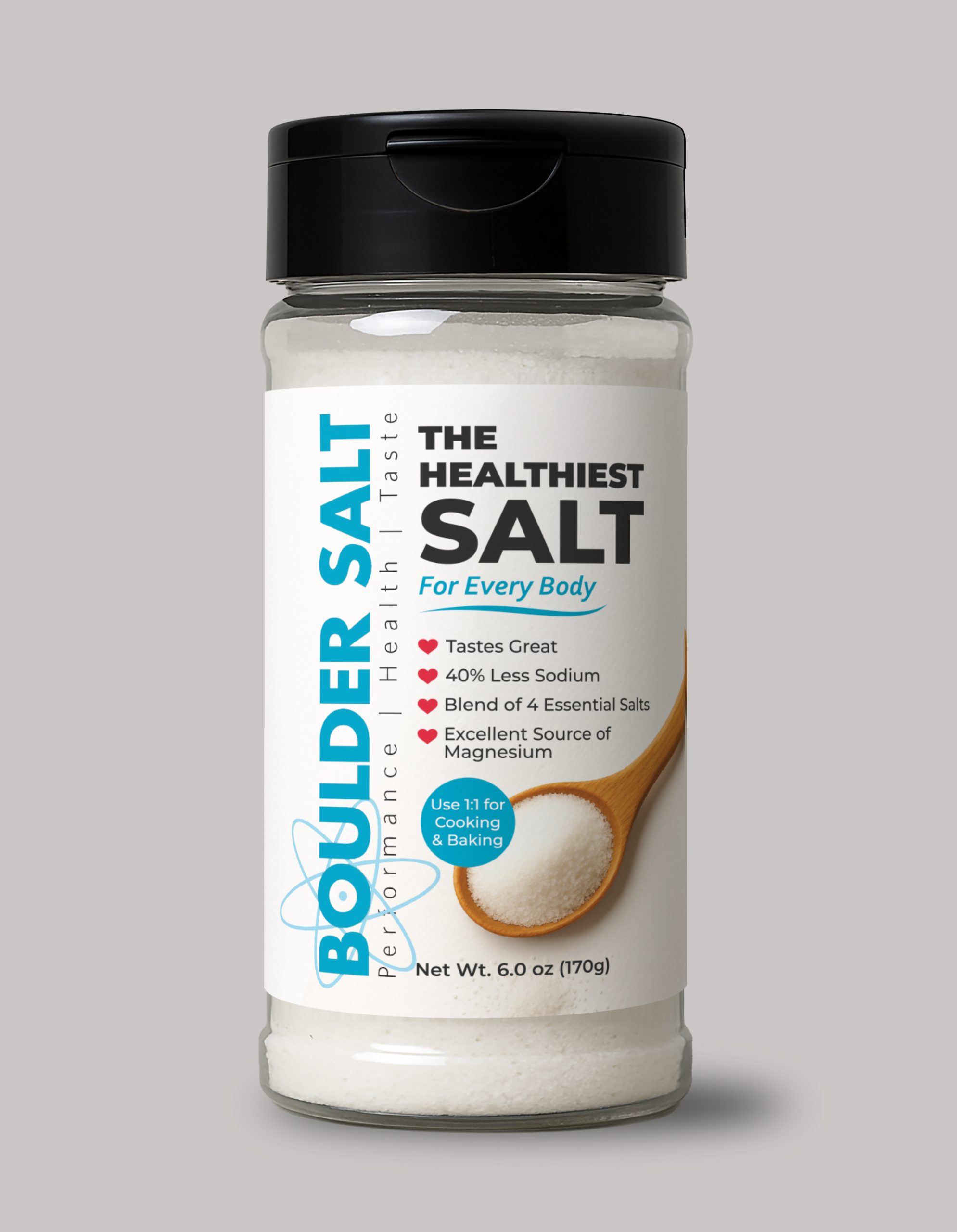
As well as containing less sodium (the WHO recommends we consume less than 2g per day), it provides you with higher levels of magnesium (35% of RDA in a serving), calcium, potassium, and bicarbonate which are all important electrolytes.
This allows you to find the right balance with your salt intake and maximize the benefits of the mineralsAll these benefits come in a salt that tastes so good it won a blind taste test against sea salt and traditional table salt – 80% of participants preferred the taste of Boulder Salt

Additional content placeholder

Most performance related salt products on the market are close to 100% sodium. Our bodies need a variety of electrolytes to perform at optimal levels – not just sodium. Boulder Salt provides a robust, alkaline blend of electrolytes, including sodium, potassium, magnesium and calcium. And in a combination that approximates what should naturally exist in the body. This ratio can help athletes optimize their performance.
It varies depending on your activity level and sweat rate. In general 4 servings is common for everyday use, up to 6 servings for endurance athletes.
If you are under the care of a physician for a medical condition, consult your doctor first.
Boulder Salt is unique in that it can be taken alone, added to water, or mixed with other beverages to up their electrolyte value. It also gives you the option to make your own sports drink – adding flavors and/or sweeteners that work for you.
Yes. If you’re looking to enhance your electrolyte levels, Boulder Salt® is an ideal way to do so! It can be added to both water and sports drinks. You will likely be surprised at how mellow it tastes in water alone. And it will not significantly alter the taste of most beverages. However, Boulder Salt is alkaline, so if you add it to an acidic sports drink (which many are), you can expect to see the drink temporarily “bubble” or foam-up.
Athletes have used Boulder Salt® during all phases of a competitive event – whenever they are accustomed to drinking water or another sports drink. It’s balanced level of electrolytes make it an ideal addition to your electrolyte replacement regime. It can help you shore up electrolytes, hydrate quickly and help prevent or eliminate cramping.
If you are undergoing treatment for a medical condition, consult your physician.
Boulder Salt® is a soft, mellow-tasting salt. The varying size and shapes of different salts provide a unique taste experience. The tiny calcium and magnesium salts, which are very mild tasting, cover the surface of the sodium and potassium crystals and provide for a mellowing of the familiar “bite” of those salts.

Yes. Boulder Salt® has nearly ½ the sodium per serving than traditional table salt. And it has a ratio of potassium to sodium, that helps the body maintain a healthy blood pressure.
YES! Boulder Salt® is much lower in sodium chloride than traditional table salt , sea salt, and Himalayan pink salt – which are all over 95% sodium, making Boulder Salt a much healthier alternative!
Alkalinizing the body means means shifting your body from an acidic state to a more neutral or alkaline state. Our normal state of being should ideally be slightly alkaline.
However, environmental factors, stress, a diet low in fruits and vegetables or high in meats and other processed foods, and especially carbonated drinks, can all push our systems into an acidic state. When your body is closer to an alkaline state, you’ll experience fewer illnesses, be better prepared to fight off disease, and simply feel better. Unlike traditional table sale and sea salt, Boulder Salt® is alkaline.
Absolutely! Boulder Salt® can be used as a 1:1 replacement for any other salt in food preparation, baking and cooking.
Boulder Salt® looks different from other salts due to the fact that it is made up of a variety of salts, rather than just one type. Both the chemical composition as well as the particle sizes of the various salts used in Boulder Salt® are different. If you looked under a microscope, you’d see that some of the salts look like “boulders”, while others are much smaller.
Boulder Salt® is a blend of naturally occurring salts including sodium, potassium, magnesium, and calcium , which are all critical on a biological level.
The ingredients in Boulder Salt are chosen based on purity, not location. We take 4 different salts and blend them together in a particular ratio to make Boulder Salt. We only use pharmaceutical grade or USP grade salts.
1/4 Teaspoon of “regular salt” weighs 1.5g while 1/4 Teaspoon of Boulder Salt weights 2.0g (more dense). Once this difference in density is taken into account, the 40% difference can be shown. For example: A typical brand of salt shows 585 mg. of sodium in 1/4 tsp. (1.5g).
The sodium in 2.0g is given by 585 x 4/3 = 780mg How much less sodium is in Boulder Salt is given by: 780-480=300 300/780 = .385 or 38.5% less (rounds to 40%)
Boulder Salt has nearly half the sodium of traditional table salt and sea salt. It also has potassium, magnesium and calcium – salts that are all critical on a biological level. (Traditional table salt is 99% sodium). Boulder Salt looks a bit different too, It has a finer texture than most other salts on the market and a more mellow taste.
The precise amount of Boulder Salt® to add to your drink depends on your sweat rate. One quarter teaspoon in a 17-20 oz drink is the recommended starting point.
The material you see that doesn’t dissolve is related the larger particle size of magnesium and calcium. It’s around 4% of the total. These particles do readily dissolve when they are exposed to an acidic environment such as in the stomach. They will dissolve right away if you keep them agitated/stirred up and drink the water with them suspended in it.
Boulder Salt® looks different from other salts due to the fact that it is made up of a variety of salts, rather than just one type. Both the chemical composition as well as the particle size of the various salts used in Boulder Salt® are different. If you looked under a microscope, you’d see that some of the salts look like “boulders”, while others are much smaller.
We do plan to offer our product in the future, with iodine. Our current formulation does not have iodine because it tends to have a metallic taste when added to water. If used simply on foods, it does not have that strong of an aftertaste. The current formula of Boulder Salt® is intended to be used in both water and on food.
Boulder Salt® is available here on our website, on Amazon, and in several states including California, Colorado, Hawaii – Kona, Massachusetts.
We currently ship to Australia, Canada and New Zealand.