
Boulder Salt has a lot of wonderful uses that we’ve already explained extensively–things including rehydration, replacing electrolytes, adding terrific flavor to food, and reducing the sodium in your diet. But let’s expand our horizons and explore what salt used to be used for and discover what salt is being used for now and into the future.
When we think of salt the first thing that we think of is that it is a great seasoning on nearly every food. Whether it’s sprinkling salt on meat and potatoes or sprinkling salt on chocolate and caramels, salt adds great flavor to whatever it touches. It is particularly good at bringing out the flavors of particularly bland foods like starches and carbohydrates, but it can help virtually everything.
Salt has been used for millennia as a preservative for all sorts of foods, including meat and dairy and fish. Before we had refrigerators we had to rely almost exclusively on preserving food with salt. And there’s no reason why we can’t return to old food preservation techniques to make some amazing recipes here and now.
Pickling is one of the most common ways that salt can preserve a food: salt brine dehydrates bacterial cells and therefore slows (or stops) the growth of bacteria in food. It will take much longer for food to spoil. It also inhibits the bacteria responsible for botulism, one of the most deadly forms of food poisoning.
Even in the age of refrigerators, we still love our salted and cured meats, as well as the wonderful variety of foods that can be pickled–everything from cucumbers to asparagus to cauliflower to cherries to mushrooms to strawberries to tomatoes–you can pickle almost anything! (And can we get a shout out for pickled herring?)
Salt acts as a binding agent when you’re binding meat together to reduce cooking losses. This is especially apparent when we make sausage: salt extracts the proteins in meat allowing it to bind together. When you’re making sausage, salt soluble protein solutions coat globules of fat, allowing for meat, fat and moisture to all be held together. Using Boulder Salt for homemade sausage is a great way to keep some of your favorite foods (and maybe favorite traditions) alive with a little less harmful effects from regular table salt!
Yes, salt can even make your food look better. This is seen easily in salty meats such as ham and bacon, where the salt, combined with sugar and nitrate, produce a beautiful warm color that we associate with well-cooked meats.
But this applies to bread, too! To get that golden crust on a loaf of bread, use salt to reduce the amount of sugar destruction and therefore increase the caramelization.
A lot of us went through a bread baking phase last year. Make it a regular habit to bake your own sourdough loaves and you can easily sub regular salt with our salt alternative, When baking, salt in the dough inhibits both yeast and mold from running wild and ruining the caked goods. Fermentation control is also important in cheese making, where salt helps to control the rate of lactic acid formulation (as well as making the cheese taste great.)
Chefs, food scientists, our team and customers at Boulder Salt are always trying to innovate and create new ways to use salt. Some of the techniques that are used that you might not think of are:
Coffee lovers often put a pinch of salt into their grounds before brewing, because it takes away the bitter taste. We may never even taste the bitter, but we know there is a physiological process taking place. Customers tell us the change is apparent with just a pinch of salt. It seemed strange to us but once we tried it we could see the appeal!
This relates to knocking down the bitterness, but by adding salt to something with a little bitterness, we can turn it sweet. Perhaps the best known example of this is sprinkling salt on grapefruit (or mixing into a Salty Dog cocktail). The bitterness decreases and we are only left with the sweet. This can enhance sickly sweet items as well, providing a little more nutrients and creating a different flavor profile.
Aromas are enhanced by the addition of salt, even if we don’t realize it. Salt, it has been said, needs to be added in the cooking phase to get the best results. When added at the table, salt becomes the dominant flavor and the other tastes don’t bind together well. But if the salt is added during cooking, you get the full benefit–and it comes out in the smell.
From ancient times to modern day there are a thousand ways to use salt in cooking – and even more ways to use it in household chores such as cleaning. This year find new ways to use salt and share your favorites with us!

Additional content placeholder

Most performance related salt products on the market are close to 100% sodium. Our bodies need a variety of electrolytes to perform at optimal levels – not just sodium. Boulder Salt provides a robust, alkaline blend of electrolytes, including sodium, potassium, magnesium and calcium. And in a combination that approximates what should naturally exist in the body. This ratio can help athletes optimize their performance.
It varies depending on your activity level and sweat rate. In general 4 servings is common for everyday use, up to 6 servings for endurance athletes.
If you are under the care of a physician for a medical condition, consult your doctor first.
Boulder Salt is unique in that it can be taken alone, added to water, or mixed with other beverages to up their electrolyte value. It also gives you the option to make your own sports drink – adding flavors and/or sweeteners that work for you.
Yes. If you’re looking to enhance your electrolyte levels, Boulder Salt® is an ideal way to do so! It can be added to both water and sports drinks. You will likely be surprised at how mellow it tastes in water alone. And it will not significantly alter the taste of most beverages. However, Boulder Salt is alkaline, so if you add it to an acidic sports drink (which many are), you can expect to see the drink temporarily “bubble” or foam-up.
Athletes have used Boulder Salt® during all phases of a competitive event – whenever they are accustomed to drinking water or another sports drink. It’s balanced level of electrolytes make it an ideal addition to your electrolyte replacement regime. It can help you shore up electrolytes, hydrate quickly and help prevent or eliminate cramping.
If you are undergoing treatment for a medical condition, consult your physician.
Boulder Salt® is a soft, mellow-tasting salt. The varying size and shapes of different salts provide a unique taste experience. The tiny calcium and magnesium salts, which are very mild tasting, cover the surface of the sodium and potassium crystals and provide for a mellowing of the familiar “bite” of those salts.

Yes. Boulder Salt® has nearly ½ the sodium per serving than traditional table salt. And it has a ratio of potassium to sodium, that helps the body maintain a healthy blood pressure.
YES! Boulder Salt® is much lower in sodium chloride than traditional table salt , sea salt, and Himalayan pink salt – which are all over 95% sodium, making Boulder Salt a much healthier alternative!
Alkalinizing the body means means shifting your body from an acidic state to a more neutral or alkaline state. Our normal state of being should ideally be slightly alkaline.
However, environmental factors, stress, a diet low in fruits and vegetables or high in meats and other processed foods, and especially carbonated drinks, can all push our systems into an acidic state. When your body is closer to an alkaline state, you’ll experience fewer illnesses, be better prepared to fight off disease, and simply feel better. Unlike traditional table sale and sea salt, Boulder Salt® is alkaline.
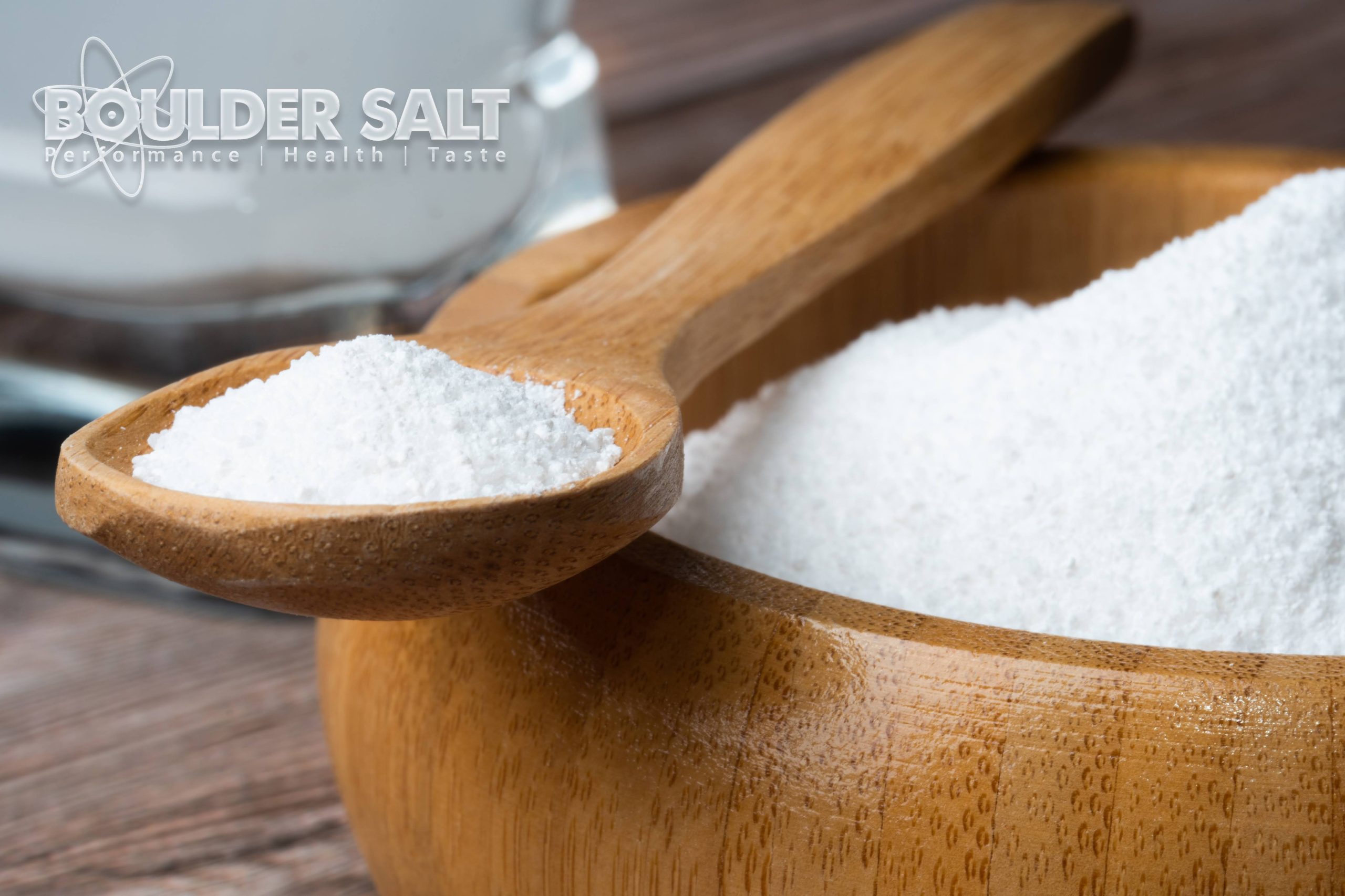
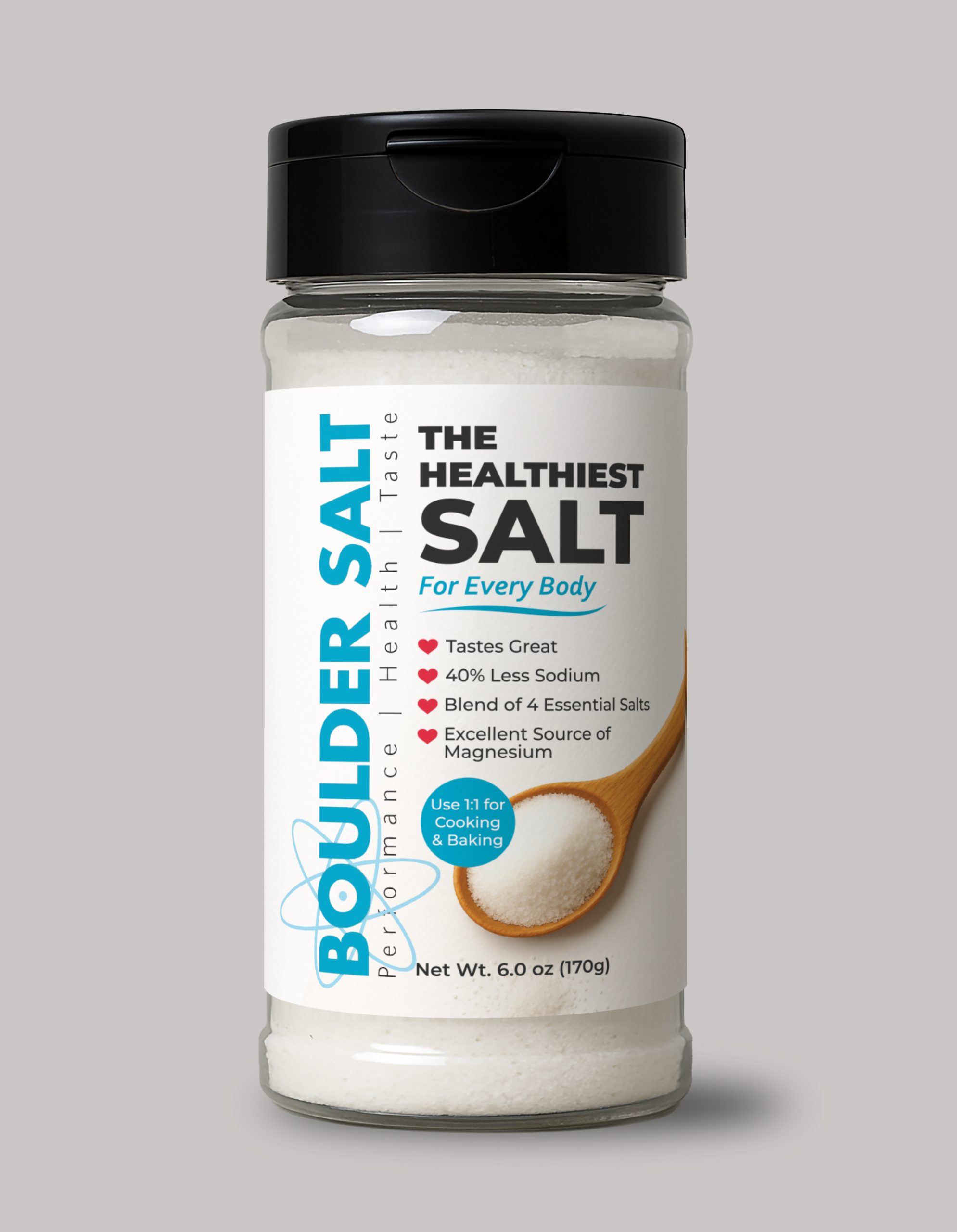
Absolutely! Boulder Salt® can be used as a 1:1 replacement for any other salt in food preparation, baking and cooking.
Boulder Salt® looks different from other salts due to the fact that it is made up of a variety of salts, rather than just one type. Both the chemical composition as well as the particle sizes of the various salts used in Boulder Salt® are different. If you looked under a microscope, you’d see that some of the salts look like “boulders”, while others are much smaller.
Boulder Salt® is a blend of naturally occurring salts including sodium, potassium, magnesium, and calcium , which are all critical on a biological level.
The ingredients in Boulder Salt are chosen based on purity, not location. We take 4 different salts and blend them together in a particular ratio to make Boulder Salt. We only use pharmaceutical grade or USP grade salts.
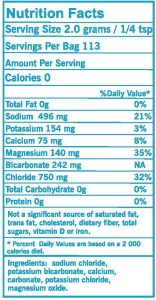
1/4 Teaspoon of “regular salt” weighs 1.5g while 1/4 Teaspoon of Boulder Salt weights 2.0g (more dense). Once this difference in density is taken into account, the 40% difference can be shown. For example: A typical brand of salt shows 585 mg. of sodium in 1/4 tsp. (1.5g).
The sodium in 2.0g is given by 585 x 4/3 = 780mg How much less sodium is in Boulder Salt is given by: 780-480=300 300/780 = .385 or 38.5% less (rounds to 40%)
Boulder Salt has nearly half the sodium of traditional table salt and sea salt. It also has potassium, magnesium and calcium – salts that are all critical on a biological level. (Traditional table salt is 99% sodium). Boulder Salt looks a bit different too, It has a finer texture than most other salts on the market and a more mellow taste.
The precise amount of Boulder Salt® to add to your drink depends on your sweat rate. One quarter teaspoon in a 17-20 oz drink is the recommended starting point.
The material you see that doesn’t dissolve is related the larger particle size of magnesium and calcium. It’s around 4% of the total. These particles do readily dissolve when they are exposed to an acidic environment such as in the stomach. They will dissolve right away if you keep them agitated/stirred up and drink the water with them suspended in it.
Boulder Salt® looks different from other salts due to the fact that it is made up of a variety of salts, rather than just one type. Both the chemical composition as well as the particle size of the various salts used in Boulder Salt® are different. If you looked under a microscope, you’d see that some of the salts look like “boulders”, while others are much smaller.
We do plan to offer our product in the future, with iodine. Our current formulation does not have iodine because it tends to have a metallic taste when added to water. If used simply on foods, it does not have that strong of an aftertaste. The current formula of Boulder Salt® is intended to be used in both water and on food.
Boulder Salt® is available here on our website, on Amazon, and in several states including California, Colorado, Hawaii – Kona, Massachusetts.
We currently ship to Australia, Canada and New Zealand.