You do not need to limit your salt intake with Boulder Salt. Salt from Boulder Salt is different chemically. That means you can regularly enjoy it and not see the adverse reactions that you’d get from other salts.
Let’s break this down with a little more scientific evidence:
According to the U.S. Food and Drug Administration, Americans eat too much sodium. But how much salt is too much, and how can we stay on the good side of our salt intake when so many of our foods are loaded with preservatives that dial up the sodium and salt content?
It’s not merely a philosophical question. Many people have the symptoms of too much salt, if they aren’t already bordering on some kind of salt overdose. That’s because while the body needs sodium and salt to function properly, too much salt can lead to high blood pressure, stroke and heart disease. And most of it comes from pre-packaged foods that give us more than 70 percent of our daily salt intake, not the table salt that is typically used to flavor foods at home.
But it’s more than low sodium that is important: getting enough potassium in your diet is equally essential, if not more so. According to the Centers for Disease Control and Prevention, “Increasing potassium intake can reduce your risk of heart disease and stroke by lowering blood pressure. Consuming too little potassium and too much sodium can increase your risk of heart disease and stroke. Lowering blood pressure reduces your risk of heart disease and stroke.”
Your Choices Matter
It starts with looking at the labels of foods that you eat. The recommended daily value for sodium is less than 2,300 mg per day per person. As for potassium, the daily recommended amount is 4,700 mg per person. It sounds easy, but it’s actually far easier to get too much salt than too little, especially if you’re not paying attention to your diet.
It also depends on the types of foods that you eat. Things like deli meat sandwiches, pizza, burritos and tacos, soups, savory snacks such as chips, chicken, pasta, burgers, eggs and omelets all supply about 40 percent of the sodium consumed by Americans. And if you’re doing a double-take because that looks a lot like your diet and the diet of others, you’re right — it’s essentially the modern American diet that’s at fault.
That said, the sodium content of many foods can vary wildly, and if you opt for low-salt or low-sodium foods, or you prepare more of your meals at home instead of relying on pre-packaged foods, you can reduce your sodium and salt intake.
And when it comes to increasing potassium, it’s a matter of not eating enough of the good stuff, not eating too much of the bad. Potassium-rich foods include potatoes, leafy greens, beans and legumes, and many types of fish. Juice from potassium-rich fruits is also great, including orange, tomato, or grapefruit.
The Risks of High Blood Pressure
Because sodium attracts water, a high-sodium diet will draw more water into the bloodstream, raising the volume of blood and eventually your blood pressure. Also known as hypertension, high blood pressure can force the heart to work harder, which can eventually harm your arteries and organs such as the heart, kidneys, eyes and brain. If left long enough, excess salt or sodium can increase your risk of stroke, heart attack, heart failure and kidney disease. In fact, high blood pressure can even cause blindness in some instances, and the risks of complications only increase with age.
How Do You Counteract Too Much Salt?
If you’re worried about the high levels of salt in your diet and your body, it may make sense to revisit your sodium consumption. Try to eat foods with known lower sodium values, as well as avoiding foods that are known to be high in sodium. Making most of your meals at home is a good idea as pre-packaged foods often contain high levels of sodium to increase shelf life.
But this must be a balanced effort: you must get plenty of potassium while limiting your salt intake. This may require some significant steps on your part to change your eating habits, but if it’s the difference between a long and healthy life or a bunch of unhealthy food, the answer seems pretty clear.
Let’s get back to the statement that we made at the very beginning: with Boulder Salt, because of its unique chemical makeup, you do not need to reduce your salt intake to stay healthy.
It’s much easier to enjoy a healthy amount of sodium when you using Boulder Salt. You can healthfully enjoy greater quantities of our salt versus any other salt. In fact, it’s an excellent nutritional salt to enjoy rather than a “guilty pleasure” to be rationed. It offers both lower sodium and higher potassium, making it the best of both worlds.
Get started by reading about healthy salt, or shop our nutritional salts here.

Additional content placeholder

Most performance related salt products on the market are close to 100% sodium. Our bodies need a variety of electrolytes to perform at optimal levels – not just sodium. Boulder Salt provides a robust, alkaline blend of electrolytes, including sodium, potassium, magnesium and calcium. And in a combination that approximates what should naturally exist in the body. This ratio can help athletes optimize their performance.
It varies depending on your activity level and sweat rate. In general 4 servings is common for everyday use, up to 6 servings for endurance athletes.
If you are under the care of a physician for a medical condition, consult your doctor first.
Boulder Salt is unique in that it can be taken alone, added to water, or mixed with other beverages to up their electrolyte value. It also gives you the option to make your own sports drink – adding flavors and/or sweeteners that work for you.
Yes. If you’re looking to enhance your electrolyte levels, Boulder Salt® is an ideal way to do so! It can be added to both water and sports drinks. You will likely be surprised at how mellow it tastes in water alone. And it will not significantly alter the taste of most beverages. However, Boulder Salt is alkaline, so if you add it to an acidic sports drink (which many are), you can expect to see the drink temporarily “bubble” or foam-up.
Athletes have used Boulder Salt® during all phases of a competitive event – whenever they are accustomed to drinking water or another sports drink. It’s balanced level of electrolytes make it an ideal addition to your electrolyte replacement regime. It can help you shore up electrolytes, hydrate quickly and help prevent or eliminate cramping.
If you are undergoing treatment for a medical condition, consult your physician.
Boulder Salt® is a soft, mellow-tasting salt. The varying size and shapes of different salts provide a unique taste experience. The tiny calcium and magnesium salts, which are very mild tasting, cover the surface of the sodium and potassium crystals and provide for a mellowing of the familiar “bite” of those salts.
Yes. Boulder Salt® has nearly ½ the sodium per serving than traditional table salt. And it has a ratio of potassium to sodium, that helps the body maintain a healthy blood pressure.
YES! Boulder Salt® is much lower in sodium chloride than traditional table salt , sea salt, and Himalayan pink salt – which are all over 95% sodium, making Boulder Salt a much healthier alternative!
Alkalinizing the body means means shifting your body from an acidic state to a more neutral or alkaline state. Our normal state of being should ideally be slightly alkaline.
However, environmental factors, stress, a diet low in fruits and vegetables or high in meats and other processed foods, and especially carbonated drinks, can all push our systems into an acidic state. When your body is closer to an alkaline state, you’ll experience fewer illnesses, be better prepared to fight off disease, and simply feel better. Unlike traditional table sale and sea salt, Boulder Salt® is alkaline.
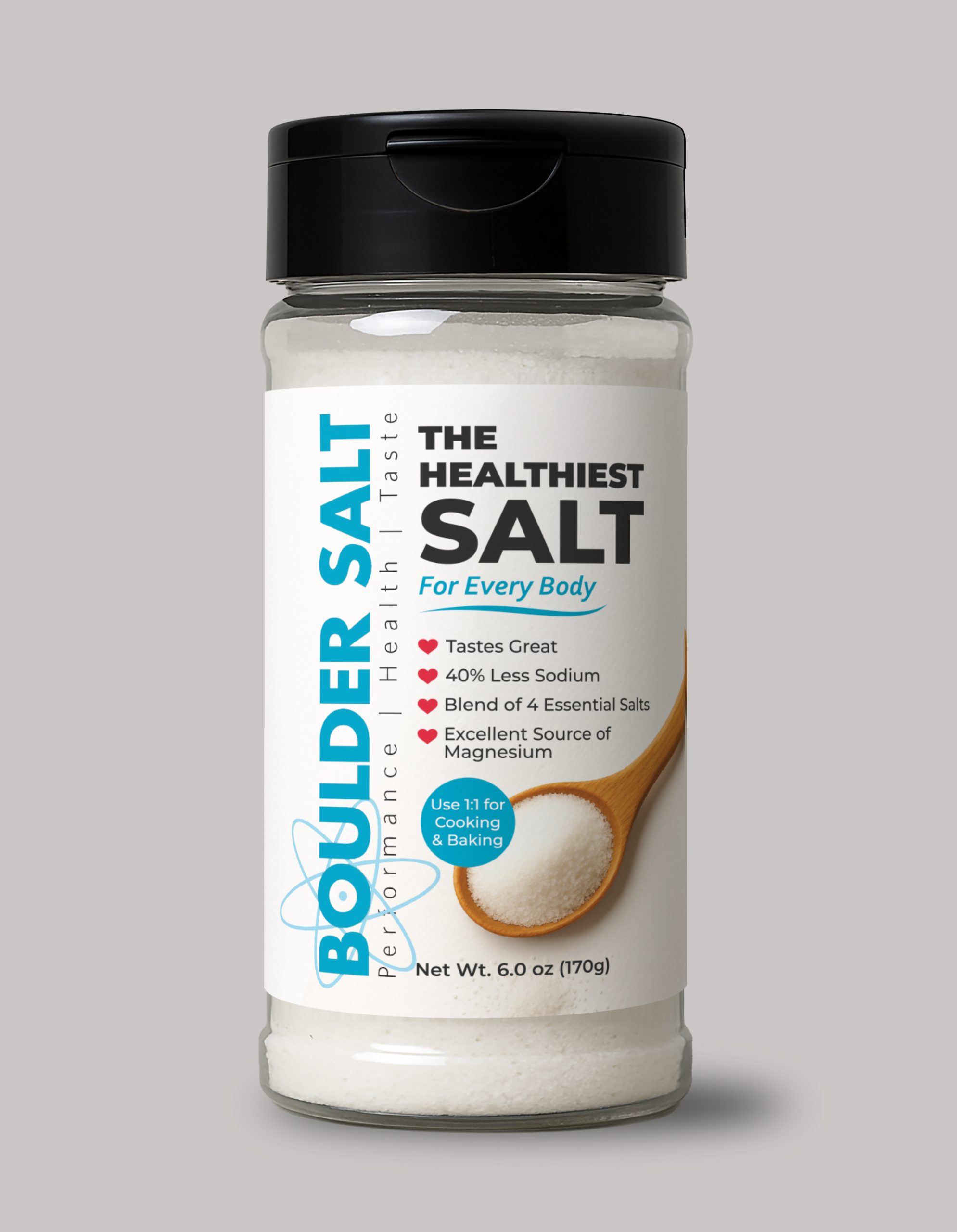
Absolutely! Boulder Salt® can be used as a 1:1 replacement for any other salt in food preparation, baking and cooking.
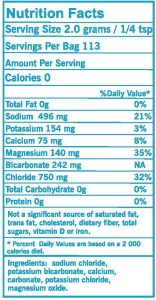
Boulder Salt® looks different from other salts due to the fact that it is made up of a variety of salts, rather than just one type. Both the chemical composition as well as the particle sizes of the various salts used in Boulder Salt® are different. If you looked under a microscope, you’d see that some of the salts look like “boulders”, while others are much smaller.
Boulder Salt® is a blend of naturally occurring salts including sodium, potassium, magnesium, and calcium , which are all critical on a biological level.
The ingredients in Boulder Salt are chosen based on purity, not location. We take 4 different salts and blend them together in a particular ratio to make Boulder Salt. We only use pharmaceutical grade or USP grade salts.
1/4 Teaspoon of “regular salt” weighs 1.5g while 1/4 Teaspoon of Boulder Salt weights 2.0g (more dense). Once this difference in density is taken into account, the 40% difference can be shown. For example: A typical brand of salt shows 585 mg. of sodium in 1/4 tsp. (1.5g).
The sodium in 2.0g is given by 585 x 4/3 = 780mg How much less sodium is in Boulder Salt is given by: 780-480=300 300/780 = .385 or 38.5% less (rounds to 40%)
Boulder Salt has nearly half the sodium of traditional table salt and sea salt. It also has potassium, magnesium and calcium – salts that are all critical on a biological level. (Traditional table salt is 99% sodium). Boulder Salt looks a bit different too, It has a finer texture than most other salts on the market and a more mellow taste.
The precise amount of Boulder Salt® to add to your drink depends on your sweat rate. One quarter teaspoon in a 17-20 oz drink is the recommended starting point.
The material you see that doesn’t dissolve is related the larger particle size of magnesium and calcium. It’s around 4% of the total. These particles do readily dissolve when they are exposed to an acidic environment such as in the stomach. They will dissolve right away if you keep them agitated/stirred up and drink the water with them suspended in it.
Boulder Salt® looks different from other salts due to the fact that it is made up of a variety of salts, rather than just one type. Both the chemical composition as well as the particle size of the various salts used in Boulder Salt® are different. If you looked under a microscope, you’d see that some of the salts look like “boulders”, while others are much smaller.
We do plan to offer our product in the future, with iodine. Our current formulation does not have iodine because it tends to have a metallic taste when added to water. If used simply on foods, it does not have that strong of an aftertaste. The current formula of Boulder Salt® is intended to be used in both water and on food.
Boulder Salt® is available here on our website, on Amazon, and in several states including California, Colorado, Hawaii – Kona, Massachusetts.
We currently ship to Australia, Canada and New Zealand.