
Tired of your restless leg syndrome running you…and wearing you out…looking for a natural high magnesium solution?
The benefits go beyond restless leg syndrome!
People (just like you and me) living with restless leg syndrome often experience disruptions to our sleep and daily activities which impact quality of life.
While the exact cause of restless leg syndrome remains unclear, research suggests that dietary factors, including healthy salt intake, can help you manage the symptoms of RLS
I’m going to tell you all about the benefits of Boulder Salt and why it’s good for folks like us with Restless Leg Syndrome. Sprinkling and dashing this mineral-rich salt into our diet can offer relief and support in managing RLS symptoms.
Have you been affected by high blood pressure or POTS? Boulder Salt may help you with that too!
<Buy Now!>
<Boulder Salt is Great on Food and High in Minerals: Buy Now for RLS!>
Magnesium is a healthy aid in stress reduction and the treatment of restless leg syndrome.
<I Need High-Magnesium Salt for my Restless Leg Syndrome!>
<Buy High Magnesium Boulder Salt Here for Restless Leg Syndrome>
Magnesium is an organic mineral that your body uses to function optimally. It’s a biochemical regulator helping the nerves, muscles, and immune system. When you are deficient in magnesium you can experience muscle cramps, contractions, and nerve impulse regulation.
Restless leg syndrome can actually be caused by a deficiency in magnesium. Consuming magnesium can reduce symptoms of RLS and lead to a more restful sleep. Magnesium is a top-shelf pick as an alternative remedy to treat your symptoms as well as the cause – if your RLS is caused by not having enough magnesium.
Magnesium is known as a natural muscle relaxer and this has been backed by science. It’s thought to work in this way because it blocks calcium to better regulate nerve function instead of using calcium to “activate” the nerve impulse. When you have low magnesium calcium can’t be blocked and nerves overstimulate and your muscles contract.
Magnesium has been found to improve insomnia as a result of restless leg syndrome.
Supplementing magnesium is a great way to approach RLS if you’re deficient.
Many people wonder if there is a cure for restless leg syndrome? Research says it’s generally a long term disorder that doesn’t have a cure. But don’t worry- symptoms can be managed.
One side effect of not having enough sleep is muscle tension. Magnesium may also help with daytime muscle tension and stress caused by restless leg.
Boulder Salt’s magnesium salt to treat Restless Leg Syndrome at home is a great idea because of its high magnesium content. It’s also high in electrolytes and alkaline. This makes Boulder Salt the best salt for restless leg syndrome.
“Our Study indicates that magnesium treatment may be a useful alternative therapy in patients with mild to moderate RLS- or PLMS-related insomnia.” (source)
Regular physical activity can help reduce the severity of RLS symptoms. Engage in moderate exercise like walking, biking, or yoga to improve circulation and promote relaxation. Incorporating relaxation techniques such as meditation, deep breathing exercises, or warm baths before bedtime can also help calm restless legs and improve sleep quality.
Incorporating lifestyle changes, seeking emotional support, and staying informed about the latest developments can help effectively manage symptoms. Furthermore, by prioritizing good sleep hygiene, maintaining a balanced diet, and exploring innovative treatment options, individuals with RLS can improve your quality of life and overall well-being. Remember, managing RLS is a journey, so be patient with yourself and work closely with your healthcare team to find the best management strategies for your needs.
Understanding the complexities of Restless Leg Syndrome is crucial in navigating the challenges it presents. Thus by implementing appropriate treatment strategies, making lifestyle changes, and staying informed about advancements in RLS research, people just like you can find relief and improve their overall well-being. Managing Restless Leg Syndrome requires a holistic approach that addresses both physical and emotional aspects, empowering you to lead a fulfilling life despite the challenges posed by this condition.
This information is not intended to replace the advice of a qualified healthcare professional in any way and is purely educational in nature. Always consult with a trusted medical doctor if you have concerns.

Additional content placeholder

Most performance related salt products on the market are close to 100% sodium. Our bodies need a variety of electrolytes to perform at optimal levels – not just sodium. Boulder Salt provides a robust, alkaline blend of electrolytes, including sodium, potassium, magnesium and calcium. And in a combination that approximates what should naturally exist in the body. This ratio can help athletes optimize their performance.
It varies depending on your activity level and sweat rate. In general 4 servings is common for everyday use, up to 6 servings for endurance athletes.
If you are under the care of a physician for a medical condition, consult your doctor first.
Boulder Salt is unique in that it can be taken alone, added to water, or mixed with other beverages to up their electrolyte value. It also gives you the option to make your own sports drink – adding flavors and/or sweeteners that work for you.
Yes. If you’re looking to enhance your electrolyte levels, Boulder Salt® is an ideal way to do so! It can be added to both water and sports drinks. You will likely be surprised at how mellow it tastes in water alone. And it will not significantly alter the taste of most beverages. However, Boulder Salt is alkaline, so if you add it to an acidic sports drink (which many are), you can expect to see the drink temporarily “bubble” or foam-up.
Athletes have used Boulder Salt® during all phases of a competitive event – whenever they are accustomed to drinking water or another sports drink. It’s balanced level of electrolytes make it an ideal addition to your electrolyte replacement regime. It can help you shore up electrolytes, hydrate quickly and help prevent or eliminate cramping.
If you are undergoing treatment for a medical condition, consult your physician.
Boulder Salt® is a soft, mellow-tasting salt. The varying size and shapes of different salts provide a unique taste experience. The tiny calcium and magnesium salts, which are very mild tasting, cover the surface of the sodium and potassium crystals and provide for a mellowing of the familiar “bite” of those salts.

Yes. Boulder Salt® has nearly ½ the sodium per serving than traditional table salt. And it has a ratio of potassium to sodium, that helps the body maintain a healthy blood pressure.
YES! Boulder Salt® is much lower in sodium chloride than traditional table salt , sea salt, and Himalayan pink salt – which are all over 95% sodium, making Boulder Salt a much healthier alternative!
Alkalinizing the body means means shifting your body from an acidic state to a more neutral or alkaline state. Our normal state of being should ideally be slightly alkaline.
However, environmental factors, stress, a diet low in fruits and vegetables or high in meats and other processed foods, and especially carbonated drinks, can all push our systems into an acidic state. When your body is closer to an alkaline state, you’ll experience fewer illnesses, be better prepared to fight off disease, and simply feel better. Unlike traditional table sale and sea salt, Boulder Salt® is alkaline.
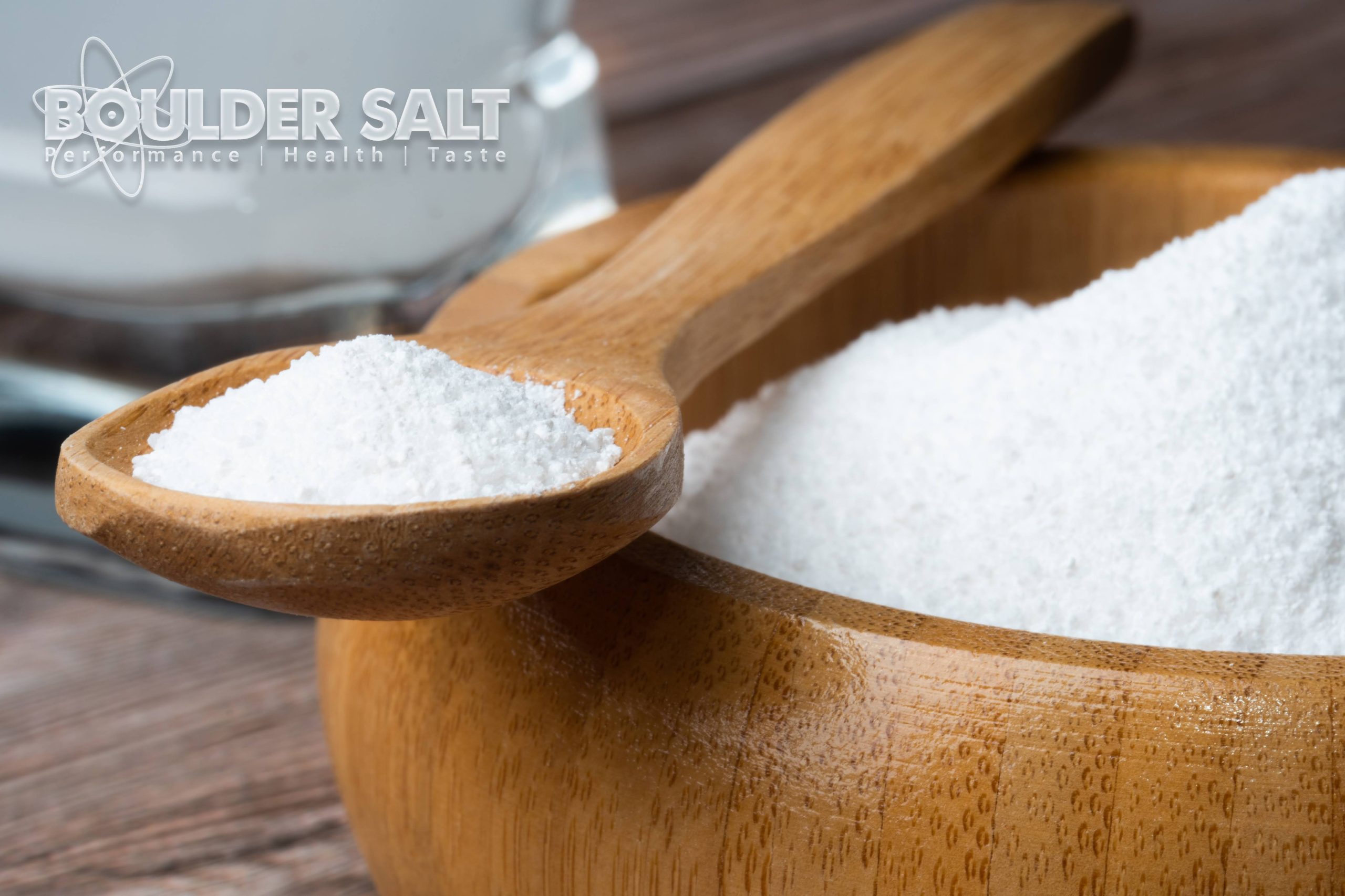
Absolutely! Boulder Salt® can be used as a 1:1 replacement for any other salt in food preparation, baking and cooking.
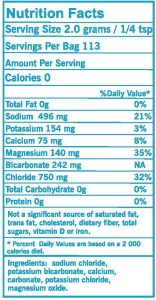
Boulder Salt® looks different from other salts due to the fact that it is made up of a variety of salts, rather than just one type. Both the chemical composition as well as the particle sizes of the various salts used in Boulder Salt® are different. If you looked under a microscope, you’d see that some of the salts look like “boulders”, while others are much smaller.
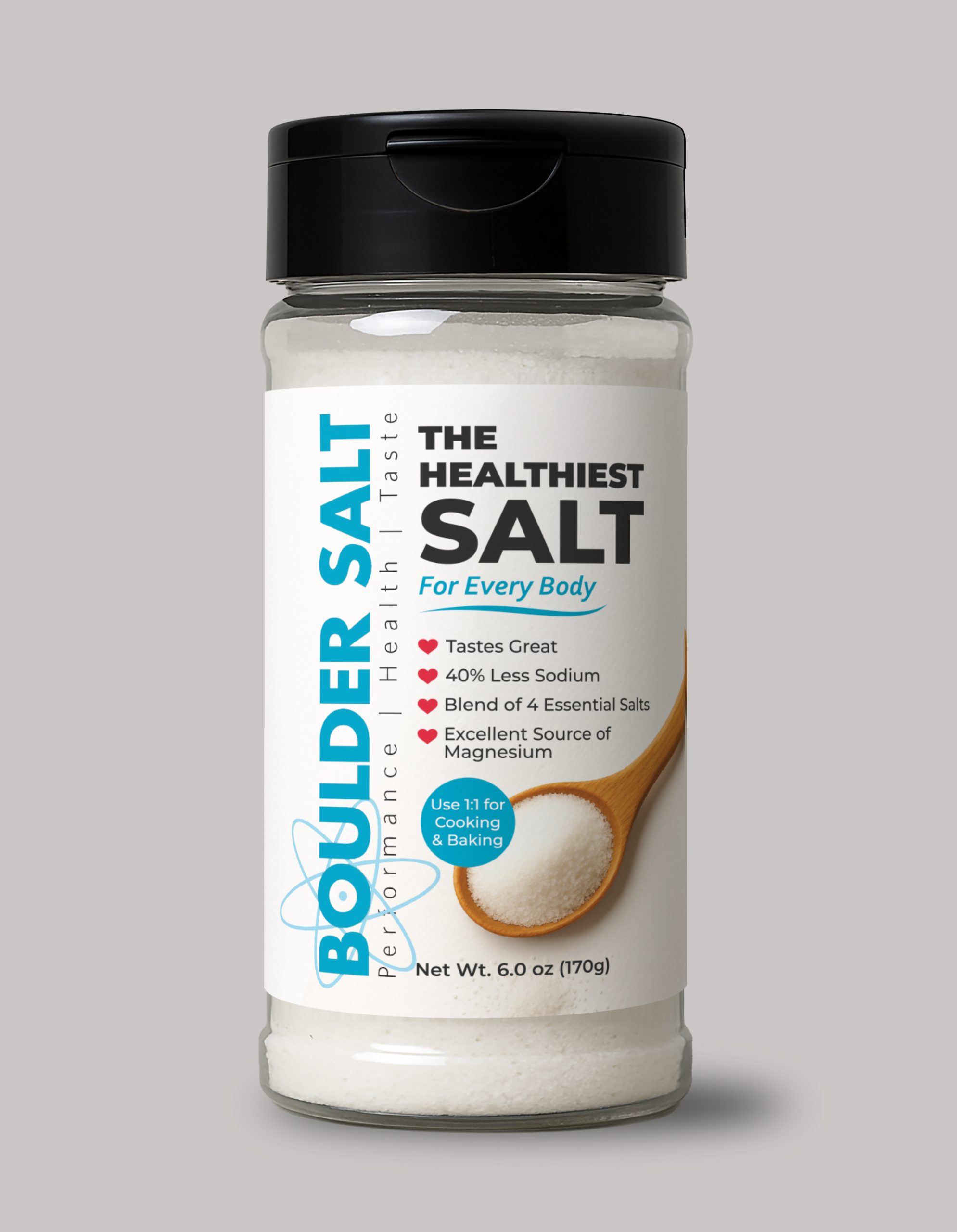
Boulder Salt® is a blend of naturally occurring salts including sodium, potassium, magnesium, and calcium , which are all critical on a biological level.
The ingredients in Boulder Salt are chosen based on purity, not location. We take 4 different salts and blend them together in a particular ratio to make Boulder Salt. We only use pharmaceutical grade or USP grade salts.
1/4 Teaspoon of “regular salt” weighs 1.5g while 1/4 Teaspoon of Boulder Salt weights 2.0g (more dense). Once this difference in density is taken into account, the 40% difference can be shown. For example: A typical brand of salt shows 585 mg. of sodium in 1/4 tsp. (1.5g).
The sodium in 2.0g is given by 585 x 4/3 = 780mg How much less sodium is in Boulder Salt is given by: 780-480=300 300/780 = .385 or 38.5% less (rounds to 40%)
Boulder Salt has nearly half the sodium of traditional table salt and sea salt. It also has potassium, magnesium and calcium – salts that are all critical on a biological level. (Traditional table salt is 99% sodium). Boulder Salt looks a bit different too, It has a finer texture than most other salts on the market and a more mellow taste.
The precise amount of Boulder Salt® to add to your drink depends on your sweat rate. One quarter teaspoon in a 17-20 oz drink is the recommended starting point.
The material you see that doesn’t dissolve is related the larger particle size of magnesium and calcium. It’s around 4% of the total. These particles do readily dissolve when they are exposed to an acidic environment such as in the stomach. They will dissolve right away if you keep them agitated/stirred up and drink the water with them suspended in it.
Boulder Salt® looks different from other salts due to the fact that it is made up of a variety of salts, rather than just one type. Both the chemical composition as well as the particle size of the various salts used in Boulder Salt® are different. If you looked under a microscope, you’d see that some of the salts look like “boulders”, while others are much smaller.
We do plan to offer our product in the future, with iodine. Our current formulation does not have iodine because it tends to have a metallic taste when added to water. If used simply on foods, it does not have that strong of an aftertaste. The current formula of Boulder Salt® is intended to be used in both water and on food.
Boulder Salt® is available here on our website, on Amazon, and in several states including California, Colorado, Hawaii – Kona, Massachusetts.
We currently ship to Australia, Canada and New Zealand.